⚠  This is an independent community project and is not affiliated with, endorsed by, or operated by Mitsue Village Government (御杖村役場).
  Phase 0 · Pre-Foundation Mitsue Village · Nara Prefecture · Japan
25-year horizon · est. April 2026
A 25-YEAR INITIATIVE · 二十五年計画
BIOMASS ENERGY & AI
Reforesting in Mitsue

Forest restoration, distributed energy, and a community-owned data center — in rural Japan.

The forest our ancestors planted — the power that sustains the village they built

The BIOMASS ENERGY & AI project repurposes an unused school or a disused village factory building and the forests around it into a single, transparent, openly replicable demonstration of rural revitalization — modest in scale, patient in horizon, built to be copied.

LOCATION
Mitsue Village Nara Prefecture, Japan
HORIZON
25 Years Bridging today to small-scale fusion
STRUCTURE
Non-profit General Incorporated Association → NPO
YEAR-3 TARGET
¥134M Five-layer funding stack
§ 01Programme

Three integrated activities, one coordinating body.

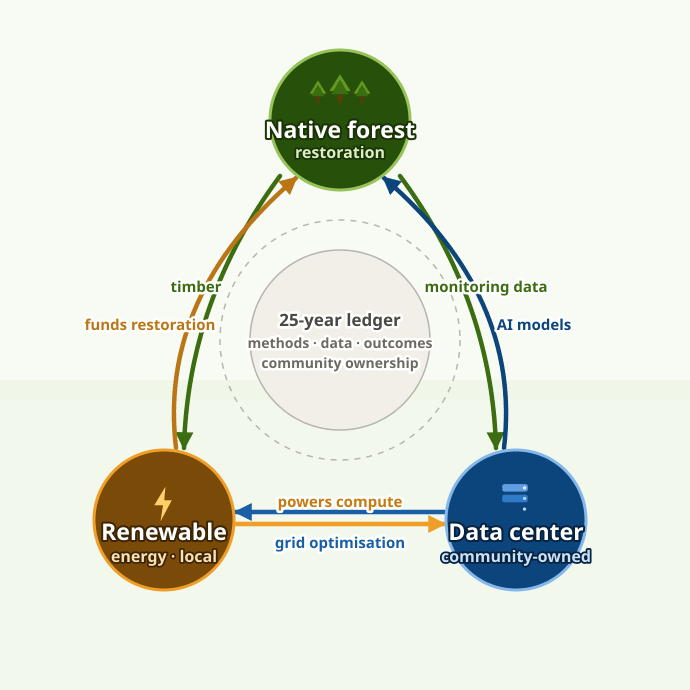
Forest restoration, locally generated renewable energy, and a small-scale community-owned data center — each reinforces the other and shares a common 25-year ledger of methods, data, and outcomes.
i

Forest Restoration

Phased replacement of aged sugi (cedar) plantations with native broadleaf species, with private landowners, the Forestry Agency (林野庁), and local contractors. Liability becomes feedstock and timber revenue.

The 25-year arc aligns to the ecological clock, not the funding cycle.

Sugi → Broadleaf · 25-year cycle
ii

Biomass CHP & Energy Resilience

The village's primary energy source is a biomass combined heat and power (CHP) system fuelled by sugi forest thinnings — generating 24/7 baseload electricity (primary output) and heat (secondary output). The forest powers the village. Solar and EV charging complement this biomass core, serving residents and visitors making the transition away from petrol.

Aging rural distribution lines make blackouts a real and growing risk. Unlike intermittent solar alone, the on-site biomass CHP runs round the clock, keeping the data center and critical facilities running through grid outages.

Biomass CHP (primary) · Solar · EV charging · Blackout resilience
iii

Community Data Center

The former Sugano Elementary School (Mitsue Taiken Koryukan / 体験交流館) — the leading candidate — or a disused village factory building — the alternative candidate; final site confirmed in Phase 1 — repurposed as a small-scale, energy-efficient edge-compute facility powered entirely by locally generated renewable energy.

Sized for accountability and community ownership — not hyperscale economics. Designed to be replicated by other depopulating municipalities.

Because the compute is village-owned, the model reserves a share for the community — free for residents, schools, and the forestry co-op — with locals able to propose their own projects: local mapping, environmental monitoring, learning tools. Who uses the data center — residents and outside tenants alike — is published openly, so the village can always see how its own resource is used.

By building a community-owned AI data center powered by locally generated renewable energy — biomass CHP and solar — Mitsue sets a working example of how rural communities can integrate technological progress with ecological sustainability. Not as opposites, but as a single coherent system. A model built to be copied.

Edge compute · Free community access · Transparent tenants · Replicable
§ 01.4 · Clean Energy Vehicle Charging

Distributed charging anchored to local generation

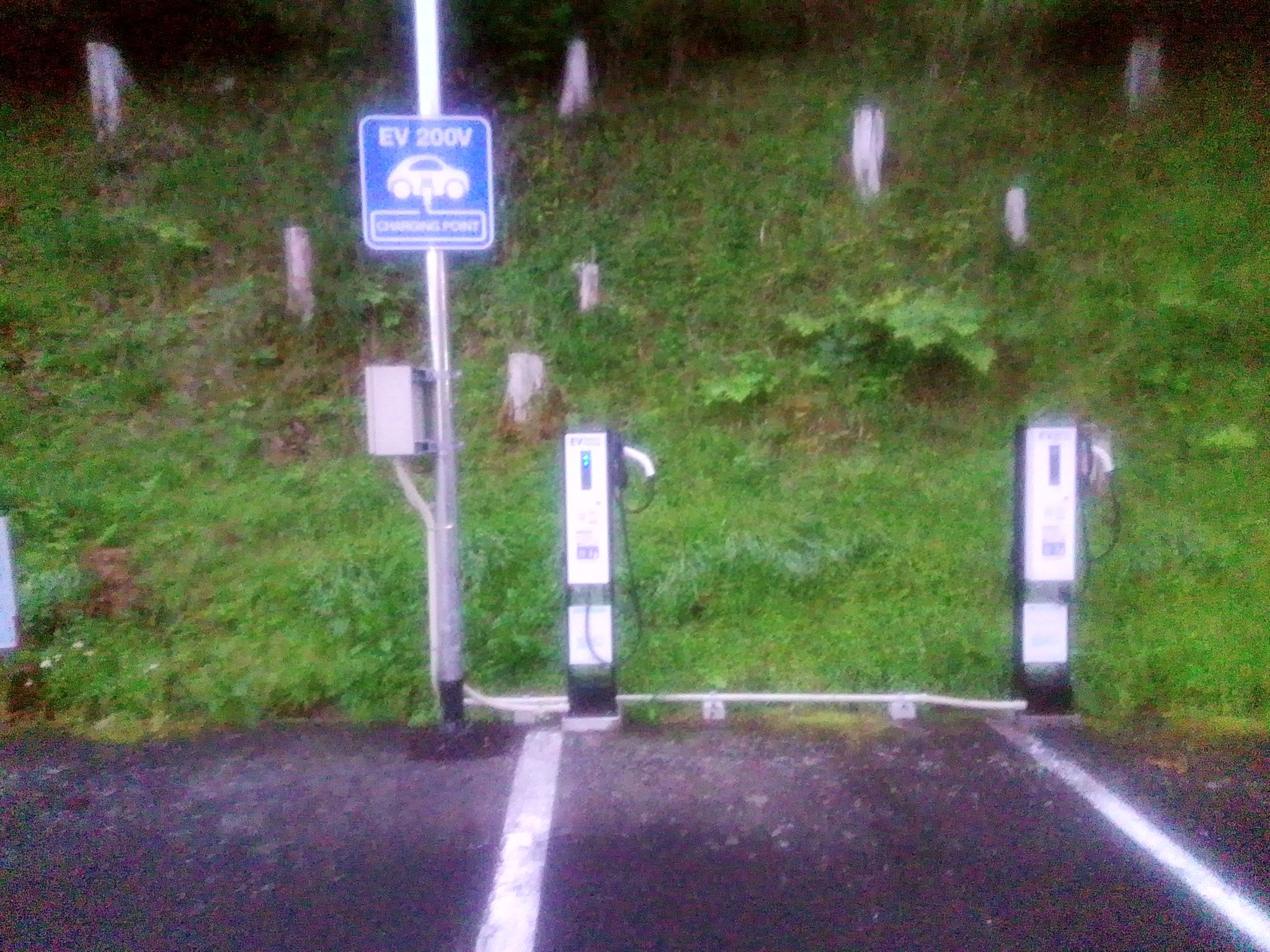
Charging infrastructure for residents and visitors, tied to on-site generation rather than waiting on capital-intensive grid extension. We build multiple, higher-powered outlets serving the full range of clean energy vehicles — EVs, PHEVs and FCVs — and equip them with external power outlets so vehicles can support the community during disasters. This follows Japan's goal of 100% electrified new passenger-vehicle sales by 2035 and the upgraded FY2024 CEV subsidy scheme (up to ¥850,000 for an EV, ¥550,000 for a PHEV or light EV), which now rewards charging infrastructure and disaster resilience alongside vehicle performance.

§ 01.5 · Open Knowledge

Documentation as a deliverable

All methods, environmental data, financial records, and lessons learned are published under permissive open licences — Creative Commons for documents, appropriate open licences for data and code — so other communities may adapt the model.

§ 02Rationale

Four converging pressures, one rural answer.

The project sits at the intersection of energy transition, forest liability, stranded community assets, and a rural digital deficit — each individually expensive to solve, all of them addressable together.
01 · ENERGY TRANSITION

Distributed generation, not grid extension.

Japan targets 100% electrified new passenger-vehicle sales by 2035 — EVs, PHEVs and FCVs, not pure-EV. Rural regions need significant new distributed generation and charging capacity; grid extension is slow and capital-intensive. Japan's FY2024 CEV subsidies (up to ¥850,000 for an EV, ¥550,000 for a PHEV) now reward charging infrastructure and disaster resilience alongside vehicle performance.

02 · FOREST LIABILITY

Aged cedar plantations as under-managed asset.

Aged sugi plantations impose ecological costs — pollen burden, biodiversity loss — and physical risks: landslide and fire. Active management converts liability into timber revenue; the sugi thinnings are the fuel for the village's biomass CHP, the project's primary energy source — generating round-the-clock baseload electricity and heat.

03 · STRANDED ASSETS

Available community facilities as anchor sites.

Underused former schools and community facilities — such as a small vacant school building or a disused village factory — currently impose net maintenance costs on shrinking municipal budgets. Productive reuse turns these into community-anchored facilities — the data center inherits a building, a community, and a story.

04 · DIGITAL DEFICIT

Edge compute where the energy is.

Rural broadband and edge-compute capacity continue to lag urban Japan. A small, energy-aligned data center addresses both the connectivity gap and the on-site computation gap at the same time.

05 · POLICY ALIGNMENT

Delivering the village's own RE plan.

The project is the implementation vehicle for Mitsue Village's official, Ministry-of-Environment-funded Renewable Energy Plan (2025). It delivers the plan's "one resilient distributed-energy site" target (currently zero) and its EV-charging priority — and unlocks the village-led 地域脱炭素移行・再エネ推進交付金 (a 2/3–3/4 subsidy on solar/battery/EV, paid through the village).

Endorsement · 推薦の声

This initiative is highly relevant and timely. It addresses both the past and present reality of rural depopulation and the socio-economic ‘impoverishment’ - or ‘desertification’ as discussed in the context of European Cohesion Policy - while also being forward-looking: engaging critically with the AI and digital economies, and confronting the global problem of monocultures and plantations that deplete biodiversity and erode resilient, thriving landscapes.

I see great relevance in such an idea — not least for the many EU countries that, like Japan, suffer from the ageing and depopulation of rural areas, with multiple negative social, ecological and economic impacts.

Re-imagining towns and villages is a wonderful and essential project. Combining ecological resilience (the replacement of cedar) with social (trust and revival), cultural (a new sense of place) and economic resilience is very promising.

Olivia Bina Co-author, “Transforming Knowledge Systems for Life on Earth”
§ 03Phased Plan

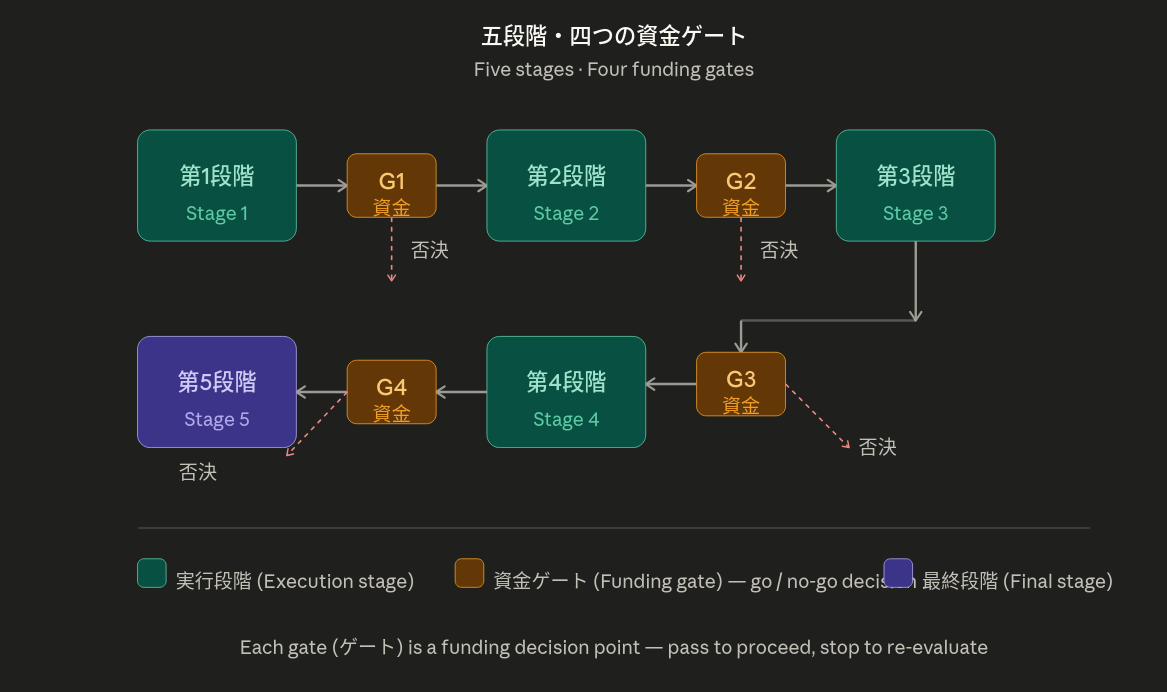
Five phases, four explicit gates.

Each phase is gated by a funding checkpoint. Failure to clear a gate triggers a hold-and-re-pitch cycle rather than acceleration into an under-resourced phase. Patient capital, deliberately staged.
Phase 0 — Current
Pre-Foundation
Months 01 – 03
Local trust-building, founding team, draft charter.
¥0 – 0.5M · self-funded
Phase 1
Foundation
Months 04 – 09
Legal entity, feasibility studies, advisors.
¥3 – 8M
Phase 2
Pilot Design
Months 10 – 18
Engineering, partnerships, permits.
¥15 – 30M
Phase 3
Pilot Build
Months 19 – 30
First-stage construction, commissioning.
¥80 – 200M
Phase 4
Operate & Scale
Months 31 +
Operations, monitoring, replication.
Revenue-led
G1 ¥3 – 8MFoundation gate
G2 ¥30 – 50MDesign gate
G3 ¥80 – 200MBuild gate
G4 Revenue onlineOperating gate
§ 04Governance

An advisory bench of builders — and a clear path to certified nonprofit status.

FOUNDER · 創業者

Rob Oudendijk

Founder of the Mitsue-kun Project. One of the founders of YR-Design, a design and technology studio based in Mitsue Nara , and a core contributor to Safecast — the open environmental monitoring network established after Fukushima. His work spans interaction design, hardware development, and open-source environmental data.

ADVISORY BOARD · 助言役員

Ray Ozzie

Executive Chair of Blues, Software pioneer; former Chief Software Architect at Microsoft. Decades of work on distributed systems, collaboration software, and the discipline of small, accountable platforms.

ADVISORY BOARD · 助言役員

San Poisson

Project Manager.

ADVISORY BOARD · 助言役員

Takuo Dome

Professor, Osaka University Graduate School of Economics / Representative Director, Inochi Forum

ADVISORY BOARD · 助言役員

Elvin Zoet

Co-Representative Director, Transom Elvin Zoet co-leads Transom, advising clients from SME to Fortune 500, Japanese and multinational. He teaches at Keio Business School. He holds a PhD in Critical Management Studies from Utrecht University.

ADVISORY BOARD · 助言役員

Yoshiko Zoet-Suzuki

Co-leads Transom, advising clients from SME to Fortune 500, Japanese and multinational. She teaches at Keio Business School. She researches family business succession at the University of St. Gallen.

ADVISORY BOARD · 助言役員

Henry Seiichi Takata

Bio EN Representative Director, SynTech Japan Co., Ltd.; member of the Japan Board of the U.S.-Japan Council. Formerly operated a biomass power plant in Mie Prefecture. Advises on biomass-CHP plant selection, grid/FIT strategy, and business development. Confirmed July 16, 2026.

FOUNDING MEMBERS · 設立メンバー
  • Rob OudendijkYR-Design · Safecast
  • Japanese Co-founderTo be confirmed
  • Founding member · 3To be confirmed
  • Founding member · 4To be confirmed
  • Target size3 – 5 total
LEGAL STRUCTURE · 法人形態の経路
  • Pre-incorporationToday
  • 一般社団法人 · Gen. Incorporated Assoc.First 6 – 9 mo
  • NPO法人 · Specified NonprofitMonths 18 – 24
  • 認定NPO法人 · Certified NPOLong-term
§ 05Funding

A five-layer stack — protecting against early dependence on any single source.

Each layer is unlocked by the deliverables of the prior phase. Figures are funding targets under the Baseline Rev 1 plan (May 2026) — sources we are pursuing or applying to, not funds secured or received; the remaining gap to the project's full budget is to be closed during Phases 2–3.
SourceTarget (unsecured)
L1 Founder / private capital Self-funded ramp; founder commitments ¥6M
L2 Government grants NEDO · METI · Nara Prefecture · Mitsue Village 地域脱炭素移行・再エネ推進交付金 (2/3–3/4, via village) ¥115M
L3 Foundations Nippon Foundation · Japan Fund for Global Environment · Toyota Foundation ¥33M
L4 Corporate partnerships Dutch and Japanese corporates; CSR-aligned ¥35M
L5 Operating revenue Hosting fees · FIT/FIP · EV charging · J-Credits ¥3M
Total funding target (unsecured) ¥192M
BAC (project budget baseline) ¥220M
Total project budget (incl. reserve) ¥245M
§ 06Operating Principles

Six principles that govern every decision.

I.
Local first

Every material decision begins with the wellbeing of Mitsue residents and landowners. Not as marketing — as a procedural rule.

II,
Open and transparent

Environmental data, financial records, and methodologies are published. The default is open; exceptions are documented.

III,
Patient and long-term

A 25-year horizon. No premature scaling. Funding gates are honored even when delay is uncomfortable.

IV.
Replicable

Documentation discipline is treated as a deliverable, not an afterthought. The point is that other villages can copy this.

V
Modest in scale

Small enough to remain accountable to the community that hosts it. Hyperscale economics are explicitly not the goal.

VI.
Non-partisan

No political alignment. Positions are confined to the project's mission and to what the published evidence supports.

§ 07Current Status

Where the project stands today, August 2026.

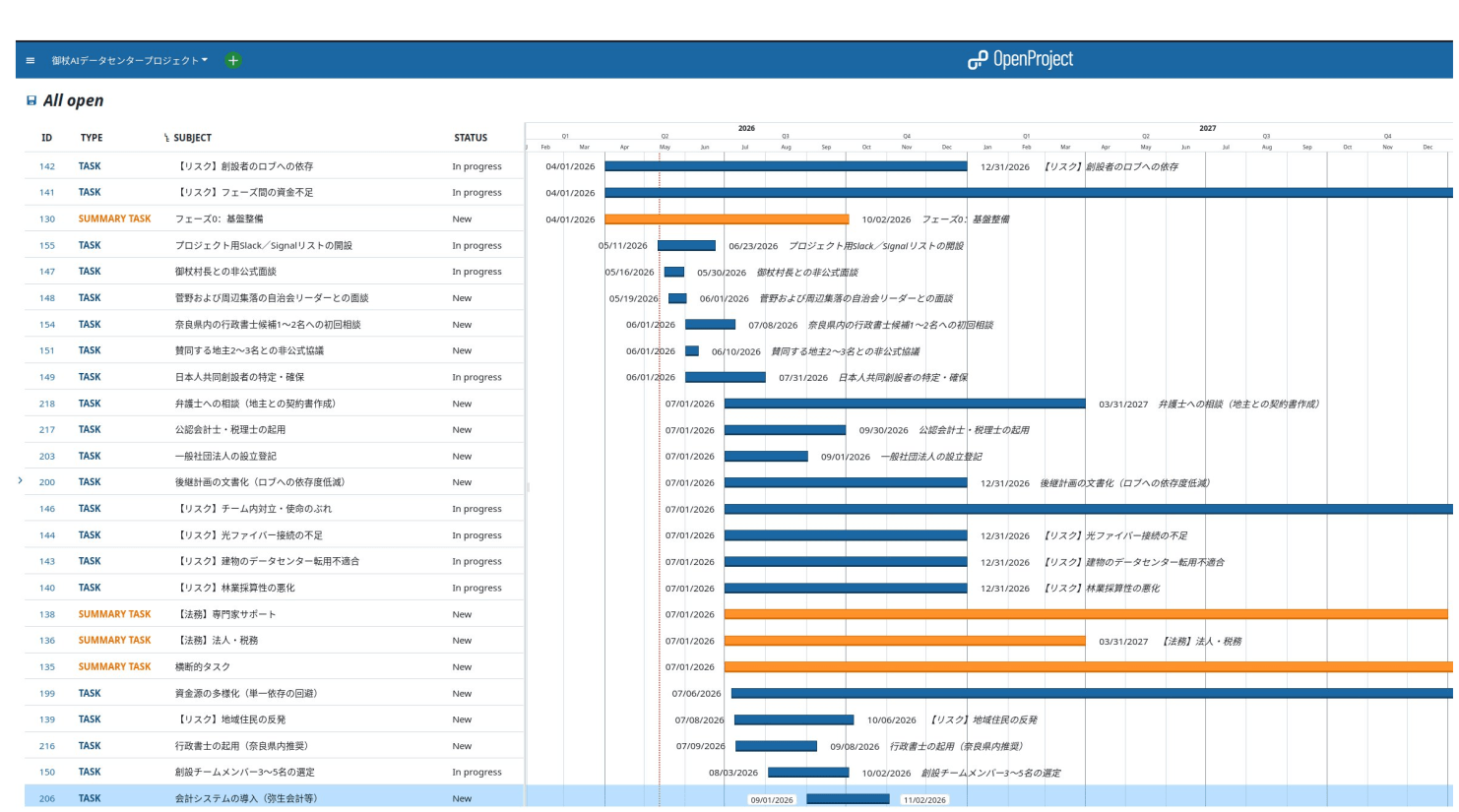
Phase 0 is intentionally quiet: no public announcements, no press. The work is local trust-building, founding-team formation, and clean drafting of the charter.
PHASE 0 · IN PROGRESS

Pre-Foundation

準備期 · 2026年4月〜10月
SELF-FUNDED · ¥0–0.5M

No public announcements yet. Formal channels — dedicated email, NPO bank account — will be established at the start of Phase 1.

COMPLETED
  • Initial meeting with Vice Mayor of Mitsue (late 2025)
  • Initial meeting with the local forestry group (early 2026)
  • Drafted founding charter and detailed implementation plan
  • Phase & funding-gate flowchart published
  • Advisory commitments: Joi Ito, Ray Ozzie, Takuo Dome, Henry Takata, ElvinZoet and Yoshiko Zoet-Susuki
  • Created Mitsue-kun, the project mascot — Mitsue-kunwho is he? ↗
IN PROGRESS
  • Identifying a Japanese co-founder with rural credibility
  • Scheduling a formal meeting with the Village Mayor
  • Drafting bylaws for a 一般社団法人
  • Engaging a 行政書士 (administrative scrivener) in Nara
NEXT 30 DAYS
§ 08 · GET IN TOUCH

For investors, foundations, and corporate partners who think in decades.

数十年単位で考える投資家・財団・企業パートナーの皆様へ

The project is currently in pre-foundation phase. We're identifying patient capital, advisory partners, and Japanese co-founders with rural credibility. If your time horizon matches ours, we would welcome the conversation.

PROJECT LEAD Rob Oudendijk YR-Design · Safecast
LOCATION Mitsue Village Nara Prefecture, Japan · 奈良県御杖村
DOCUMENT REPOSITORY https://codeberg.org/YR-Design/mitsue-ai-data-center Founding charter · implementation plan · stakeholder map · finance workbook